Form
ErgoSys Rail Cranes are designed in seven basic configurations.
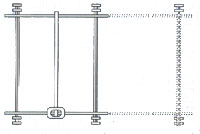
Bridge cranes accommodate rectangular workspace. Bridge systems can be mounted to a ceiling or installed as free-standing with floor anchors. These enclosed-track systems are available in lightweight (250-500 lb. capacities) or heavy-duty rail (1,000-2,000 lb. capacities). Both sizes offer a free range of motion and are enhanced ergonomically by controlled oscillation action at both ends. Your load automatically follows your lead with consistent ease.
Jib Cranes offer 180°-360° rotation in a circular area. Jibs are available with straight or articulating booms. Standard mounting is to either floor or pillar, but may require a special foundation in some cases. Movement is freer at the end of the boom, but becomes more restricted as the load is moved toward the pivot. If more than 40% of your work is done within the inner half of the radius of your straight boom jib crane, you may want to consider an articulating jib.
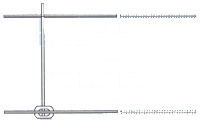
Monorails are a simple solution to an application requiring linear travel along one axis, and are most commonly used in maintenance, storage and transfter areas.
Fit
Your lifting system should fit your workspace.
Over-extending a bridge length can result in more work for your operator, and even equipment failure. In higher volume areas, shorter spans are recommended. Longer bridges are generally used in low volume or maintenance and storage areas.
When ceiling mounting a bridge system, the structural integrity of the building must be taken into consideration. ErgoSys Rail’s unique suspension system allows freedom from interference of structural supports.
Free-standing, or floor-supported, systems require specific concrete reinforcements of at least 6 inches, but eliminate overhead stress to your existing structure.
Function
The demands of your task are answered by design.
A properly designed ergonomic handling system is proven to reduce the risk of lost time injuries and workers compensation claims. The system should be adaptable to any operator positioned at the work station.
Manual work stations are more productive and time efficient than motorized crane systems. However, if the load must be controlled over an inaccessible area, such as a vat or pit, then you should consider a motorized system.
|